 As an educator, I know how important it is to read to children every day. I am always reminding parents to read to their children before putting them to bed each night. As a fifth grade teacher, I require 20-30 minutes of daily reading and send home weekly Reading Logs to be filled out. But how many of us have our children doing math problems before bedtime?
Laura Bilodeau Overdeck, has launched Bedtime Math, a website that gives parents free daily math problems to solve. Since research shows that “early math skills are a better predictor of academic success than reading ability”, Overdeck is hoping that Bedtime Math will alleviate the math anxiety that some children have. I know that I have certainly experienced that in my classroom. Many times I have heard students say, “I’m just no good at math.” It would be very beneficial if we could make them feel as good about their math skills as they do about reading. The question is, how do we do that?
“Everyone knows they should read a book to their kids before bed,” Overdeck says, “but nobody knows they should be doing math too.” Overdeck holds pajama parties, where the children can live out geometry by pedaling square wheeled trikes over curved tracks, make their own card-stock clocks and tangrams, and count out glittery animal stickers and paste them onto homemade dominoes. Could that be the answer we are looking for? So far, there is no research to back up her claims–most of the data is anecdotal. But it does sound like an interesting theory.
For more information about math problems before bedtime, you can read about it in the February 25, 2013 issue of TIME Magazine.
By Andrea Tait, Private Tutor
 During the summer, I was presented with a unique situation. “Peter” was a high school student interested in taking pre-calculus. This was not the most unreasonable request, but “Peter” was different. A student of a boarding school, he was only home for 6 weeks last summer. Still, not that unusual. But unlike most situations where parents want their kids to stay on track during the summer, “Peter” went to his mother and
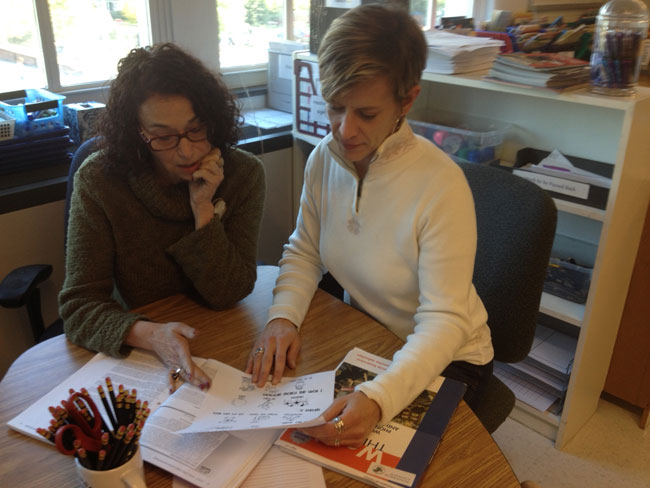
  Conferences provide one of the best opportunities during the school year for parents and teachers to share important information. At times perspectives will differ but the goal of the conference will be the same: for the child to make academic progress, to feel valued and to be successful. Research has shown that when parents and teachers work together everyone benefits. The suggestions below will ensure that both parents and teachers arrive at the destination – your child’s successful academic achievement – with a clear and shared understanding of the journey ahead.
 Phonics? Phoneme? Phonemic Awareness? These are words that are constantly thrown around almost interchangeably in the education world, but many parents do not know the difference between these words or even their true meaning. So what is “phonics” and why is it important? More importantly, why do parents need to know more than just the 26 letters of the alphabet?
 In his book,